
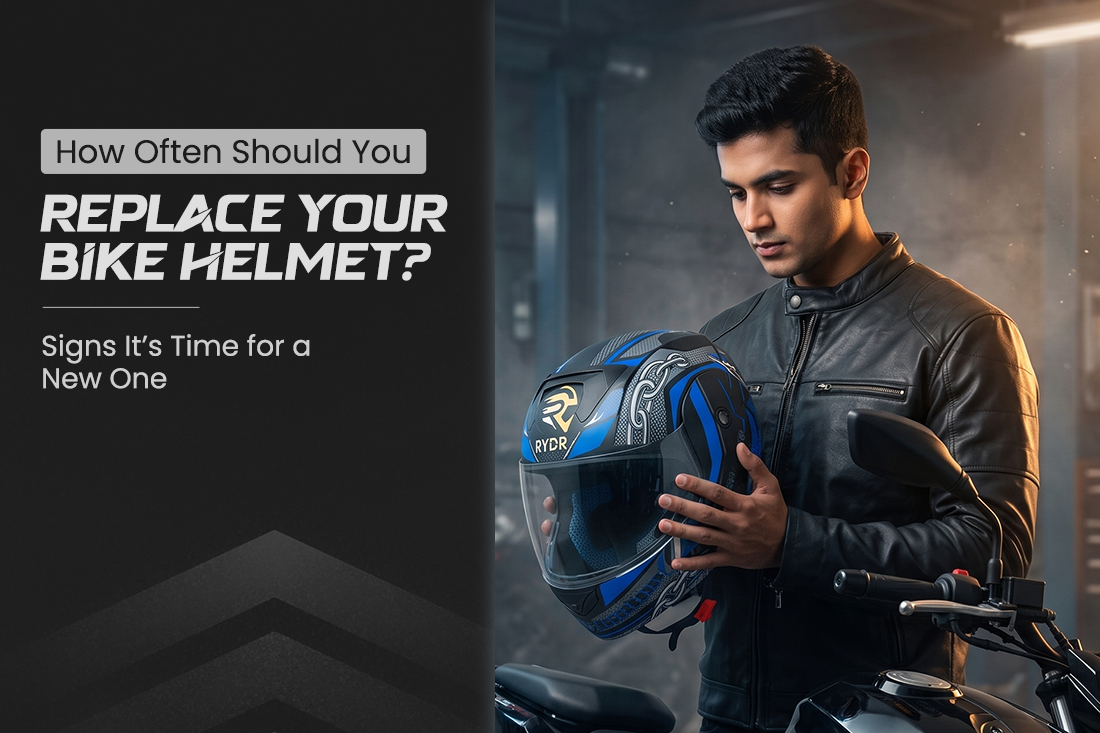
Your helmet can look perfectly fine after years of riding.
The shell may still look clean. The visor may work. The straps may still fasten properly.
But that does not always mean the helmet should keep going. A helmet goes through regular exposure to sweat, sunlight, dust, handling, and everyday wear. Its inner materials can also change with repeated use.
So, how often should you replace it? Read this blog to find out!
How Often Should You Replace a Helmet?
There is no single replacement period that applies to every helmet.
General manufacturer guidance commonly places replacement around three to five years, depending on use and condition.
We at RYDR recommend replacing your helmet every 2–3 years, based on the kind of usage. Our guidance is intentionally more conservative than that wider range, reflecting how much wear a helmet typically sees in everyday Indian riding conditions.
If you feel your helmet needs replacing, start with three things: age, usage, and condition.
Someone who rides to work every day puts considerably more use into a helmet than someone who rides occasionally. Sweat, sunlight, and repeated handling become part of its regular environment.
Replace a helmet when it reaches the replacement period recommended by its manufacturer, even if it still looks usable.
More importantly, some situations call for replacement much sooner.
Replace Your Helmet After an Impact
This is one situation where you should not wait for the helmet to reach a certain age.
A helmet can sustain internal damage during an impact without showing obvious damage on the outside. The protective materials may have absorbed some of the impact and may no longer provide the same protection.
BIS guidance for IS 4151:2015 states that a helmet subjected to severe impact should be discarded, even when damage may not be readily apparent.
So, if your helmet has been involved in a crash or taken a significant impact, replace it.
A quick look at the shell isn't enough to confirm it is still safe to use.
6 Signs Your Helmet Needs Replacing
Age is only one part of the decision. Your helmet may need replacing earlier if its condition has changed.
1. The Shell Has Cracks or Significant Damage
Inspect the outer shell from time to time.
Look for cracks, serious damage, deformation, or other critical signs of deterioration. Pay attention to areas that may have taken an impact.
If you notice serious damage, stop using the helmet and replace it.
2. The Inner Padding Is Coming Apart
Look inside your helmet regularly.
If the lining is peeling, coming apart, crumbling, or showing significant deterioration, it is time to take a closer look at the helmet's condition.
Some helmets have replaceable interior components. If the manufacturer provides suitable replacement parts, check whether they are intended to be replaced separately.
If the deterioration affects the helmet's structure or fit, replacing the entire helmet may be necessary.
3. The Padding Has Compressed and the Helmet Feels Loose
The padding inside a helmet can compress with regular use. As this happens, a helmet that once felt snug may start feeling loose or less stable.
You may notice more movement when you turn your head or ride at higher speeds. Check the interior padding and overall fit if this happens.
If the helmet no longer sits securely on your head, it may be time to replace it.
4. The Chin Strap or Buckle Is Damaged
The retention system needs to work properly every time you ride.
Check the chin strap and buckle for fraying, damage, or signs of excessive wear. If the fastening mechanism no longer works as intended, the helmet should not remain in regular use.
IS 4151:2015 includes testing requirements for the retention system and chin strap, highlighting their role in helmet performance.
5. The Smell Does Not Go Away
Sweat and regular use can leave an odour inside a helmet.
Clean the removable or washable components according to the manufacturer's care instructions. Give the helmet enough time to dry properly before using it again.
If a strong odour remains despite proper cleaning and care, inspect the interior for deterioration. A persistent smell can be a sign that the lining has seen considerable wear.
At that point, replacing the helmet may be worth considering, particularly if it has already been used for several years.
6. The Helmet Has Been Used Heavily for Years
Sometimes there is no dramatic warning sign.
You simply realise that the same helmet has been part of your daily commute for years.
Regular exposure to sweat, sunlight, and repeated use can contribute to wear. The absence of visible damage does not automatically mean the helmet should be kept indefinitely.
If your helmet has reached the manufacturer's recommended replacement period, consider its service life complete.
Does an Older Helmet Stop Working Suddenly?
Not necessarily.
A helmet does not have a specific day when it suddenly stops providing protection. Replacement timelines are recommendations based on expected service life, usage and condition.
Think of it as a point at which replacing the helmet becomes the sensible approach rather than waiting for visible deterioration.
Your riding routine also matters. A helmet used for a daily commute experiences a very different level of use from one worn only a few times each month.
That is why RYDR recommends replacing helmets every 2–3 years based on usage.
What Should You Check Before Replacing Your Helmet?
Before deciding whether your current helmet has reached the end of its usable period, check:
-
Age: When was it purchased or manufactured?
- Usage: How frequently do you ride?
- Impact history: Has it ever been involved in a crash or significant impact?
- Shell: Are there cracks or serious signs of damage?
- Interior: Is the lining peeling, crumbling, or deteriorating?
- Padding: Has the interior become compressed?
- Retention system: Are the strap and buckle working properly?
- Fit: Does it still sit securely without excessive movement?
- Odour: Does a strong smell remain after proper cleaning?
- Manufacturer guidance: What replacement period does the helmet maker recommend?
If there has been a significant impact or serious damage, do not wait for the recommended replacement date.
What Should You Look for in a Replacement Helmet?
Once your old helmet has reached the end of its service life, the replacement should meet the applicable safety requirements for your riding needs.
For motorcycle helmets in India, BIS identifies IS 4151:2015 as the standard for protective helmets for motorcycle riders. The Indian government's Quality Control Order also requires covered two-wheeler helmets to conform to the applicable Indian Standard and bear the BIS Standard Mark.
Fit matters too. A helmet should sit securely without creating painful pressure points or moving around when you ride.
When replacing an old bike helmet, do not choose purely on appearance. Consider certification, fit, usage, and the conditions in which you ride.
Conclusion | When Should You Finally Retire Your Helmet?
If your helmet has taken a significant impact, shows serious damage or no longer fits properly, replacement should not wait.
If none of those apply, check its age and usage against the manufacturer's guidance. RYDR recommends replacing helmets every 2–3 years based on usage.
The goal is simple: do not wait until your helmet looks obviously unusable.
A helmet is safety equipment. Knowing when to replace it is part of using it responsibly.
FAQs
1 . How often should a bike helmet be replaced?
Replacement periods vary by manufacturer, usage, and condition. General manufacturer guidance commonly falls around three to five years, while RYDR recommends 2–3 years based on usage.
2 . Should I replace my helmet after a crash?
Yes. A helmet involved in a significant impact should be replaced, even if you cannot see obvious external damage.
3 . Can an old helmet still look fine?
Yes. A helmet can look fine while its padding or other components have experienced years of use. Check its age, condition and the manufacturer's replacement guidance.
4 . How do I know if my helmet has become too loose?
Put it on and fasten the strap correctly. It should sit securely without shifting excessively when you move your head. If it has become noticeably loose, inspect the padding and check the manufacturer's fit guidance.
5 . Should I replace a helmet if it smells bad?
Not necessarily immediately. Clean the helmet and its removable components according to the manufacturer's instructions first. If a strong odour remains and the interior shows significant wear, consider replacing it.


Leave a comment
This site is protected by hCaptcha and the hCaptcha Privacy Policy and Terms of Service apply.