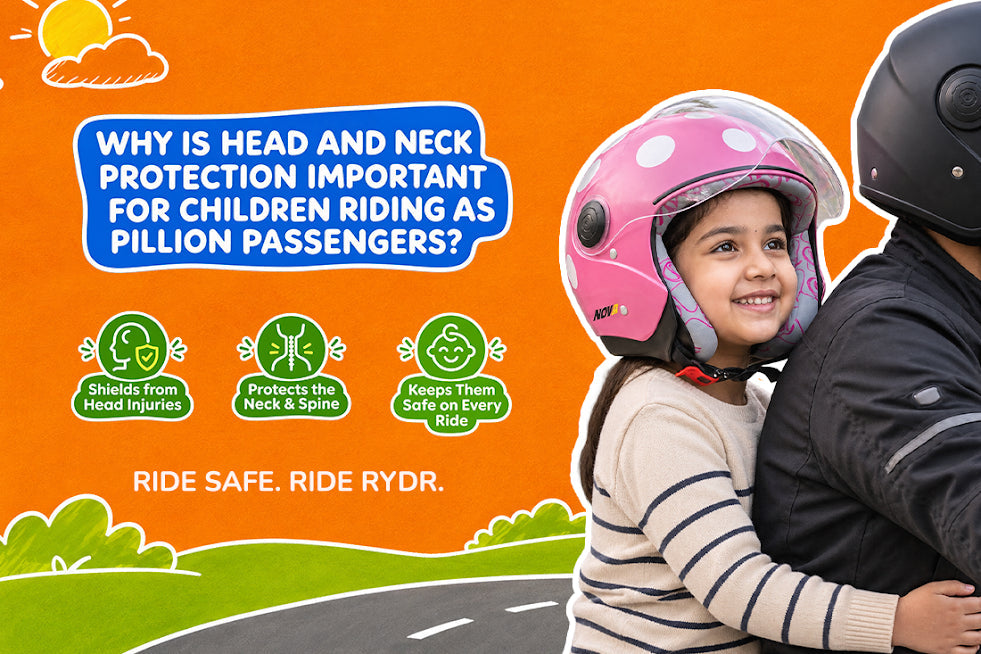
For many Indian families, a two-wheeler is the everyday way to reach school, the market or a relative's home. Children often ride along as pillion passengers. But a child on the back seat is not a small adult, and a fall from a moving bike can hurt them far more.
So why do head and neck protection matter so much for young pillion riders? The answer lies in how children's bodies respond to a crash, what the rules in India say, and how to choose a kids helmet that fits properly.
Why Children Are More Vulnerable on a Two-Wheeler
Children's heads are proportionally larger and heavier relative to their bodies, while their neck and upper-body muscles are still developing. In a sudden stop or fall, the head can move quickly, and a young child has little ability to brace for it.
Pillion children also face a few extra risks:
- They sit behind the rider and often cannot see a hazard coming.
- Younger children may doze off, slouch or lean sideways during a ride.
- There is no handlebar to hold, so balance depends on the rider and the child's grip.
Even a low-speed city fall can bring a child's head into contact with the road, a kerb or another vehicle.
Why Head Protection Matters
The World Health Organization states that safe, quality helmets reduce the risk of death in a road crash by over six times and the risk of brain injury by up to 74%. These figures apply to motorcycle riders in general, not children specifically, but they show what a well-made, properly worn helmet can do.
There is one condition: the helmet must fit and be fastened. WHO also notes that helmets that are not properly fastened increase the risk of death and injury. A helmet that slides, tilts or comes off in a fall cannot do its job.
Where Neck Protection Fits In
It helps to be realistic here. A helmet is designed mainly to protect the head, and it does not make the neck injury-proof. What a good kids helmet can do is avoid adding to the problem.
- Light weight: A heavy or oversized helmet can put extra strain on a child's neck.
- A secure fit: A helmet that stays in place does not shift or twist during sudden movement.
- Chin and jaw coverage: A full-face design protects more of the face than an open-face one.
Safe riding habits matter just as much. Keep the child seated upright, with feet on the footrests, and brake smoothly.
What Do the Rules in India Say?
Section 129 of the Motor Vehicles Act allows the central government to make rules for the safety of children below four years carried on motorcycles. The Ministry of Road Transport and Highways notified these rules in February 2022. For children below four years, they provide for:
- A safety harness that attaches the child to the rider.
- A crash helmet for the child.
- A maximum speed of 40 km/h while the child is carried.
The harness must be able to hold up to 30 kg. Road safety bodies such as the International Road Federation have also urged that a child's safety should not be judged by age alone. Rules can change, so check the latest MoRTH notification or your local traffic rules, and choose a helmet that carries genuine certification details.
How to Choose a Kids Helmet in India
When shopping for a kids helmet, check these essentials first:
- Certification: Look for genuine certification details instead of relying on a printed logo or a seller's claim.
- Right size: Measure around the widest part of your child's head, just above the eyebrows. RYDR's size guide starts at 55-56 cm (Size S), and its kids helmets are listed for ages 7-13.
- Snug, level fit: The helmet should sit level without wobbling or leaving painful pressure points.
- Strap check: Fasten the chin strap on every ride and make sure it stays secure.
- Clear visor: A scratch-free visor helps with visibility and protects against dust and wind.
- Condition: Avoid cracked shells, worn padding or second-hand helmets with an unknown history.
Do not use toy helmets or a child-sized cap. They may look similar but are not made for road use.
Safe Pillion Habits for Parents
- Ride at a moderate, steady speed, especially with younger children.
- Make sure the child's feet reach the footrests.
- Ask the child to hold on and sit upright.
- Avoid carrying a sleepy child without a harness.
- Never let a child ride without a helmet, even for a short trip.
Explore RYDR's Kids Helmet Collection
A child's helmet should be light and comfortable enough to be worn willingly, every time. RYDR offers kids helmets in open-face and full-face designs with clear visors and easy-to-follow size guidance, so you can match the helmet to your child's head measurement.
Explore RYDR's kids helmet collection and pick a helmet that fits securely for every ride.
Final Thoughts
Children on the pillion seat depend on the rider for their safety. A certified, properly fitted kids helmet, a secure strap and steady riding habits give them a far better chance in a fall.
The rules in India are a starting point, not the finish line. Prioritise certification, fit and comfort, and make the helmet a non-negotiable part of every ride.

Leave a comment
This site is protected by hCaptcha and the hCaptcha Privacy Policy and Terms of Service apply.